
San Francisco
Bay Area · Central Valley agriculture · PG&E transmission · wine country · Monterey · the Sierra wildfire zone.
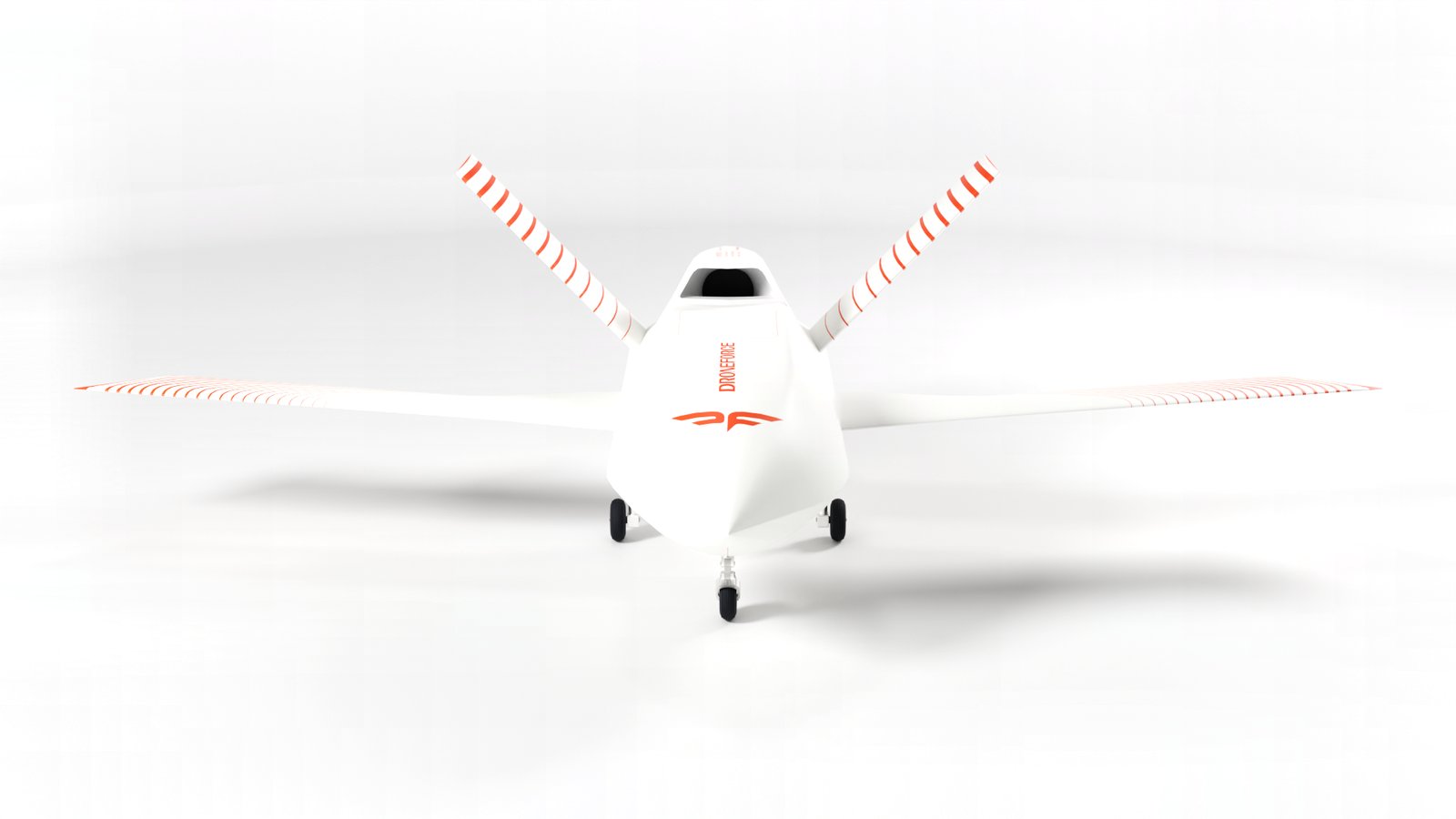
Autonomous, long-range fixed-wing aircraft. 100+ mile range. Part 108 ready. Manned-aircraft-quality sensor payloads. Networked and integrated with the systems you already run — so pipeline, utility & rail, and agriculture are finally addressable.
Between short-range delivery drones and Group 3+ military platforms sits a 60–185 mile band of US airspace incumbents can’t economically cover — the BVLOS dead zone. It’s the Droneforce™ sweet spot. One aircraft unlocks the corridor; a networked Droneforce™ fleet upgrades your operation.
Range is abstract. A radius on a map is not. From any operating base, Droneforce™ 55 reaches anything inside a 100-mile circle — persistently, autonomously, without ground-based radio infrastructure. And because satellite coverage reaches everywhere, mission command runs from any desk on Earth — San Francisco, Houston, Detroit, or wherever the operator happens to be.
Bay Area · Central Valley agriculture · PG&E transmission · wine country · Monterey · the Sierra wildfire zone.
Gulf Coast petrochemical corridor · Port of Houston pipelines · East Texas oil & gas · Beaumont refining belt.
Great Lakes rail corridors · Michigan agriculture · southern Ontario gas infrastructure — and, from the XPONENTIAL floor, the length of Michigan’s linear infrastructure network.
100+ mile range per aircraft stacks into continuous coverage along the corridors that matter. One networked Droneforce™ fleet covers a multi-state pipeline end-to-end — deconflicted and scheduled by Droneforce One, integrated with the systems your operations team already uses.
1,500 miles to image. End-to-end coverage.
An autonomous fixed-wing airframe engineered to manned-aircraft reliability and safety standards. Designed around a simple premise: if the aircraft can’t stay aloft long enough, reach far enough, and carry the right sensor, the data doesn’t exist. Every subsystem — airframe, propulsion, autonomy, payload, link — is engineered toward that outcome.
The electric motor is self-contained and quieter than an open rotor. Neighborly overhead for the communities below and safer on the ground for lightly trained crews and bystanders.
Methane sensors, hyperspectral imagers, mapping-grade LiDAR. Most small UAS can carry one at a time. Few have the bay volume or modularity for the full pro-grade stack.
Live mission view from any desk, in-flight retasking as the operation evolves. Designed so the operator doesn’t need to be in the field — just connected.
Pipeline, power, farmland, infrastructure — the operations the country actually runs on. Droneforce™ delivers persistent autonomous coverage at distances and economics that no previous generation of commercial platform could match.
Persistent corridor inspection for oil, gas, and utility rights-of-way. Automated anomaly detection, geo-referenced reporting, and revisit cadences the crews you have today can’t match.
Multispectral and EO/IR mission profiles across large acreage. Crop health indices, irrigation stress mapping, and season-long temporal stacks — at the revisit frequency the crop actually needs.
Pipeline, utility transmission, and rail are three expressions of the same capability — linear BVLOS corridor inspection with real-time data backhaul. The missions helicopters used to fly, at a cadence and cost profile that matches how fast the asset actually changes.
Search-and-rescue, wildfire surveillance, and US defense operations run on a higher-performance Droneforce™ HP airframe. Distinct platform, program, supply chain, and team from the commercial fleet.
Long-range autonomous fixed-wing is an integration problem. These are the four sub-systems we didn’t cut corners on.
Automated corridor, grid, and persistent-loiter mission generation. Contingency logic and fail-safe behaviors built in, not bolted on.
Compute for real-time detection, classification, and geotagging at the airframe. Reduces link bandwidth, accelerates time-to-insight for customers.
Persistent satellite connectivity for command-and-control and payload downlink. Global coverage without terrestrial radio infrastructure.
Droneforce One schedules, deconflicts, and coordinates a networked fleet across distributed sites. Open APIs let your dispatch, asset-management, and data pipelines talk to the network directly — one integration covers every aircraft.
The Droneforce™ 55’s airframe, avionics, and supply chain are aligned with the commercial BVLOS regulatory path from day one — Part 108, BlueUAS, and the FAA waiver workflow operators actually fly under.
Part 107 compliant for line-of-sight operations today. For BVLOS inspection corridors, we work with operators on FAA waivers — the standard industry mechanism for reaching BVLOS operations under current rules.
Airframe, avionics, and autonomy designed for Part 108, not retrofitted.
Supply chain, components, and software pipeline architected to satisfy BlueUAS criteria from the first flight. Eligible for federal civilian procurement.
Active coordination with FAA-coordinated test ranges for autonomy, link, and payload validation. Repeatable environment as the program progresses toward operational authorization.
A founder and advisory bench drawn from Lockheed Martin, Northrop Grumman, Scaled Composites, NASA, and the US Air Force. The unfair advantage is knowing what not to redesign.
Former Lockheed Martin drone engineer, with a successful mid-career exit already on the board. Multiple years of industry experience across Energy, Utility, and Defense. BS aerospace engineering for the airframe, MS industrial engineering for mass manufacturing and system integration, and an MBA for strategy and commercial execution.
Operators, integrators, investors, and DoD program officers route through different inboxes. Choose your lane and we’ll respond within one business day.